


How Alpine may be F1’s best ‘worst team’ of all time
Alpine is set to be the best-performing team ever to come last in an F1 world championship


Pierre Gasly, Alpine
Photo by: James Sutton / Motorsport Images
Nobody ever wants the wooden spoon in the Formula 1 world championship, for valid reasons – a crucial loss of prize money, and the mere incentive to do well – but if you’re ever going to come last then Alpine certainly is doing it right.
The Enstone-based outfit has already scored 20 points in the 2025 season, by far the most a last-placed team has ever collected – and that’s just over 14 grands prix this year.
Of course, the points system has evolved over the years, but Alpine’s 20 points roughly matches Toro Rosso’s eight in 2009 – except that was over a 17-race campaign.
Back then, Toro Rosso’s points solely came from lower top-eight finishes by Sebastien Bourdais and Sebastien Buemi, but with the current system, the team would have scored 29 points that year – with the caveat of more attritional races, which made it easier for a weak team to occasionally finish in the top 10.
Another interesting metric is qualifying performance, with Toro Rosso making it out of Q1 14 times out of 34 possible. Alpine currently is on 18/34, which includes sprints – otherwise 16/28 over regular qualifying sessions.
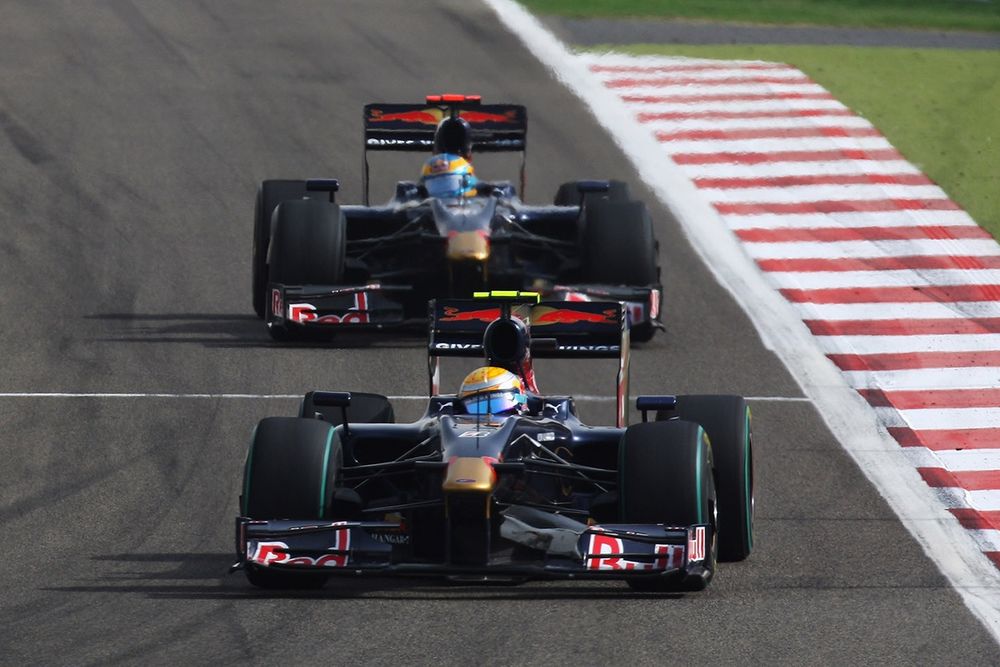
Sebastien Buemi, Toro Rosso, Sebastien Bourdais, Toro Rosso
Photo by: Mark Thompson / Getty Images
Alpine’s situation is also different because its second car has been vastly underperforming at the hands of Jack Doohan and Franco Colapinto, failing to record a single top 12 on Sundays. This means Pierre Gasly has single-handedly scored Alpine’s 20 points, with his best result sixth at Silverstone, so the team clearly has potential for a bigger haul. However, not finishing last will be a tall order, with Haas currently 15 points up.
Coincidentally, Haas recorded the second-biggest tally (not taking into account different points systems) with 12 points over the 22-event 2023 season – nine from Nico Hulkenberg and three from Kevin Magnussen, including seventh place for the German in Melbourne. In terms of qualifying performance, this translated to 34/56 qualifying sessions in the top 15 (27/44 without sprints).
Haas did have highlights such as Hulkenberg qualifying second in Canada and fourth for the Austrian GP sprint, outperforming Gasly’s high of fifth in Bahrain this year and Toro Rosso’s Buemi qualifying sixth for the 2009 Brazilian GP.
Haas cars reached (S)Q3 no fewer than 14 times in 2023, but struggled to convert it into Sunday results. A high-profile instance was Hulkenberg dropping from second to seventh in the early stages of the Canadian GP before an untimely safety car intervention scuppered his chances of a points finish.
Finally, another strong contender for ‘best worst season’ would be Minardi in 2005 – at least on paper. The team scored seven points, more than the five it collected in the preceding 10 years, with fifth and sixth in the infamous six-car United States Grand Prix.

Patrick Friesacher, Minardi PS05
Photo by: Sutton Images
However, the Italian squad was a true backmarker that year, as shown by its highest qualifying result of 13th for Patrick Friesacher in Monaco and Christijan Albers in Japan, while their best finish (other than Indianapolis) was 12th by Friesacher in Bahrain and Albers in Belgium.
Overall, there have been 13 instances of a last-placed team scoring points in F1 history, across nine different teams; the first occurrence was Arrows collecting two points in 2002, courtesy of Heinz-Harald Frentzen with a brace of sixth places.
Other squads include Minardi (2004, ’05), Spyker (2007), Toro Rosso (2009), Manor (2016), Sauber (2017, ’24), Williams (2018, ’19, ’22), Haas (2023) and currently Alpine.
Additional reporting by Norman Fischer

Share Or Save This Story


FIA explains software glitch that caused Bahrain GP in Malaysia race delay

Russell: “You’ve got to laugh” at bad luck as F1 title drifts away

You Ask The Questions: Emerson Fittipaldi


Alonso showed championship credentials on F1 debut - ex-Minardi boss

Top 10 Minardi F1 drivers ranked: Alonso, Webber, Badoer and more

The longest-serving Red Bull driver revealing F1’s true brutality

No denying it now – the one reason why F1’s ‘horrible’ start in Malaysia could be a good thing

Inside Alonso's decision to contest the 2027 Dakar Rally with Aston Martin

The greatest F1 campaigns with no wins

MotoGP to introduce sprint qualifying amid 2027 format changes
Subscribe and access Autosport.com with your ad-blocker.
From Formula 1 to MotoGP we report straight from the paddock because we love our sport, just like you. In order to keep delivering our expert journalism, our website uses advertising. Still, we want to give you the opportunity to enjoy an ad-free and tracker-free website and to continue using your adblocker.


Top Comments