

Halo saved Charles Leclerc from visor strike in Spa start crash
The FIA's investigation into the Belgian Grand Prix start crash has concluded the halo saved Charles Leclerc from being hit on the visor by Fernando Alonso's endplate, Autosport can reveal


Following weeks of analysis of video footage and data from the cars involved, the final report on the accident has concluded that the halo did play a crucial role in saving Leclerc from injury or worse.
The report by the FIA Global Institute, the findings of which are revealed here for the first time, have given the clearest indication yet of how well the halo stood up to the crash.

Not only did the cockpit protection system remain "structurally intact and in a usable condition" following the 58kN impact from Alonso's right front wheel - with Sauber able to remove the halo without issue after the event - it also helped deflect the McLaren away.
Pictures of the accident captured by the FIA's high-speed cockpit camera showed that Leclerc was only hit by small pieces of carbon debris from Alonso's car as it flew over his cockpit.
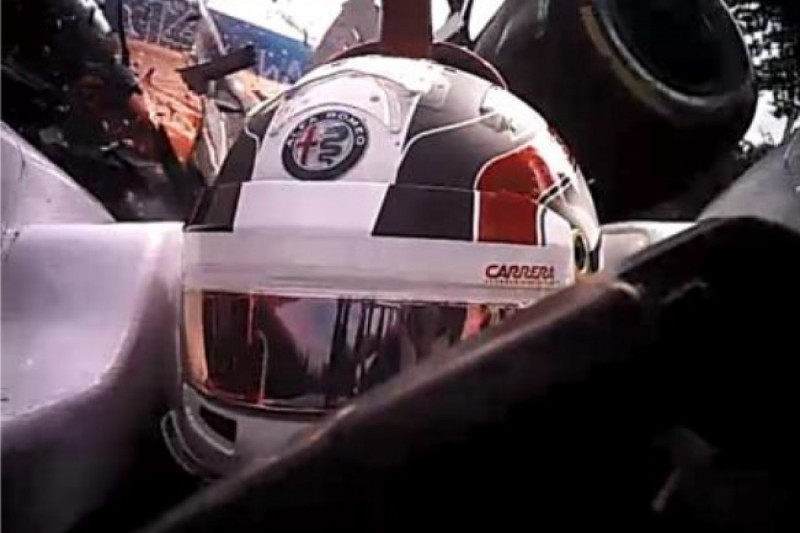
Although the investigation concluded that the front-wheel trajectory would not have brought it into contact with Leclerc's head, it believes the McLaren's front wing endplate was on course for Leclerc's visor.
Speaking exclusively to Autosport about the results of the investigation, the FIA's safety director Adam Baker said: "From the available data and video footage, we are confident that the wheel would not have hit Leclerc's helmet.
"But, as Alonso's car continued to yaw relative to Leclerc's, we believe that Alonso's front wing endplate would have just contacted Leclerc's visor.
"It is difficult to predict the severity of the contact with any precision, though."
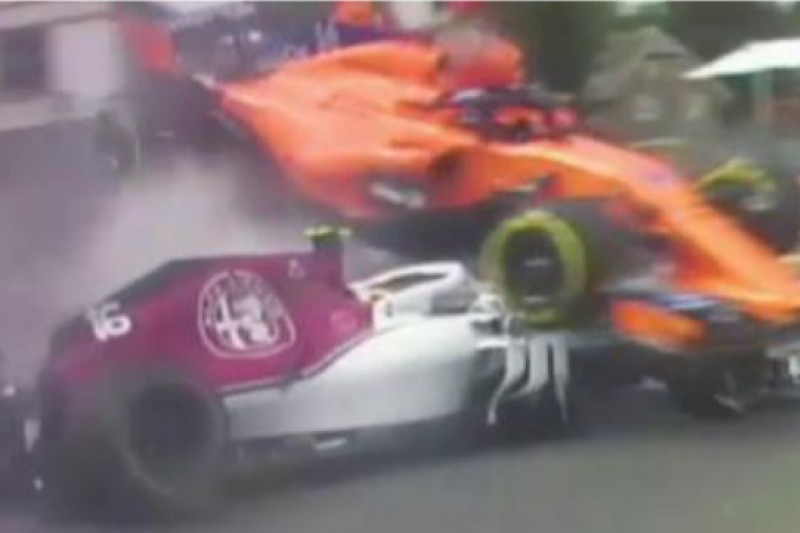
The report confirmed that the main point of contact was Alonso's right-front wheel striking the right-hand upper side of Leclerc's halo.
Analysis shows that the relative velocity between the two cars was approximately 30km/h (19mph), with an estimated impact angle of 90 degrees.
This clash with the halo was enough to break the suspension on Alonso's car, but the right-front wheel rim remained intact and the tyre appeared to have remained inflated. Leclerc's right rear suspension was broken in the accident.
Key report findings:
* The estimated peak force imparted on the Halo was 58kN, this being 46% of the 125kN FIA prescribed load requirement for the Halo and chassis attachment points. The contact position during the crash was close to the load application point for the homologation tests.
* If the wheel had contacted Leclerc's helmet with a similar force, there would have been potential for a very serious head or neck injury.
* The energy and force of a wheel impacting the halo is inherently limited by the speed and mass of the wheel assembly and strength of the attached suspension.
If the full mass of the car had impacted the halo loading through the primary structure, the impact energy would have been approximately 30kJ (based on 840kg at 30km/h). Such energy would have devastating consequences if it loaded directly onto the driver.
However, the halo would not be able to absorb all this energy without significant deformation and probable failure.
* An investigation by Sauber has confirmed that the halo structure, its attachments and the chassis were not damaged or deformed due to the engagement with the wheel.
Share Or Save This Story


Brundle awarded OBE in King’s New Year’s honours

The new rules dilemma that will define the 2025 F1 season

Jon Noble: An unfair perception or a genuine concern? Lifting the lid on Red Bull’s Tsunoda scepticism


What is left to fight for in F1 2026?

Leclerc penalised for Lawson clash; Antonelli and Oliver Bearman also punished after F1 Brazilian GP

Hamilton needs "serious talks" with himself as well as his team-mate

Verstappen hits back after Russell criticism: “He’s so far below my level”

Mercedes on the ropes as Verstappen delivered knock-out in Las Vegas fight night

“My mistake was to lift” – Why Antonelli lost power in Las Vegas GP victory battle

Super Formula Suzuka: Nojiri ends drought with win in season finale
Subscribe and access Autosport.com with your ad-blocker.
From Formula 1 to MotoGP we report straight from the paddock because we love our sport, just like you. In order to keep delivering our expert journalism, our website uses advertising. Still, we want to give you the opportunity to enjoy an ad-free and tracker-free website and to continue using your adblocker.


Top Comments