


How Hamilton dominated in Qatar despite missing a key Mercedes advantage
There was simply no stopping Lewis Hamilton on Formula 1's first visit to Qatar. The Mercedes driver eased to pole position and led every lap to secure an utterly dominant victory - even without a key Mercedes weapon in his arsenal to increase the heat on Red Bull heading into the final two races of the gripping 2021 title race

“They have woken up the lion. He’s absolutely on it. Brutal. And cold-blooded.”
Toto Wolff is in no doubt that Lewis Hamilton’s reaction to his qualifying disqualification at Interlagos has spurred his charge into producing his very best form just as this ultra-close title fight with Max Verstappen reaches its climax. Hamilton channelled his energy to a famous win in the middle of Formula 1’s final 2021 triple header, then drew on it again to absolutely dominate the championship’s first visit to Qatar.
That he did it sporting a rainbow helmet livery to show his support for the LGBTQ+ community in a part of the world where basic human rights remain sadly restricted for some, simply added to his greatness. This was Hamilton at his very best, all while actually missing a key Mercedes strength that could have had him going even faster.
Hamilton has now started on the front row of an F1 race 171 times in his illustrious career. In Qatar, Pierre Gasly was making his first appearance at the grid’s head. Pre-race, paddock figures wondered how much the AlphaTauri driver would risk a bold move on Hamilton in a bid to help stablemate Max Verstappen’s chances, with the Dutchman deservedly dropped five places from qualifying second for his late Q3 yellow-flag breach.
That incident had been caused by Gasly running wide over the raised kerbs behind the Turn 15 high-speed left – the Losail track’s penultimate corner – breaking his front wing and giving him a puncture. It aided the Frenchman’s high-starting spot and also foreshadowed the race’s real drama.
When the lights went out, Hamilton immediately moved right to cover Gasly’s run on the inside line to the long, switchback Turn 1 right-hander and from there he promptly disappeared. By the end of lap one of 57, he was 1.9 seconds clear of the pack.
“I generally felt I wasn’t massively under threat,” Hamilton said of his getaway. “I managed to cover the ground just off the start and after that it was just head down and focused on trying to bridge the gap.”

Hamilton eased into the lead at the start, as Verstappen advanced to fourth behind Gasly and Alonso
Photo by: Jerry Andre / Motorsport Images
He was soon doing so over Verstappen, who made up for his Q3 mistake by making a brilliant start from seventh. He roared past the slow-starting and also-penalised Valtteri Bottas – the Finn finding “just no grip” on cold tyres.
At Turn 1, while Lando Norris and Carlos Sainz Jr were busy fighting on the outside line, Verstappen simply used his RB16B’s awesome downforce advantage and hugged the inside like no one else could – moving up to fourth and almost fully alongside Fernando Alonso – the Alpine driver having chased Hamilton and Gasly closely through opening corner from his penalty-elevated third-place starting spot.
Here, Verstappen was suddenly in trouble, as the unsighted Alonso swung right on the racing line into the long, left-hand Turn 2. Verstappen had to take evasive action and jinked half onto the artificial grass runoff to his right, dropping back behind Alonso and nearly Norris too.
As Verstappen was dusting himself off, Alonso was putting in a brilliant exit from Turn 2 to get alongside Gasly and then pass him on the inside line at Turn 4 – not an easy overtaking place. He set off after Hamilton, with the former Red Bull team-mates chasing in his wake.
Verstappen was in clear air but found himself struggling with lift-off oversteer at Turn 1 and understeer elsewhere as a result of minor front wing endplate damage he’d picked up during the opening two laps, with heavy kerb strikes at Turns 14 and 15
Not long after Verstappen had complained he was “stuck” behind Gasly, the AlphaTauri driver slid off at the exit of the final corner and paved the way for the Red Bull to shoot by at the start of lap three. Two laps later, Verstappen used DRS to easily overcome Alonso on the main straight and, like so often this year, it was suddenly a two-horse race between F1’s leading contenders.
Except, really, it wasn’t. By the time Verstappen had cleared Alonso, Hamilton was 4.2s ahead – an advantage he nearly doubled over the next 11 laps. Verstappen was in clear air but found himself struggling with lift-off oversteer at Turn 1 and understeer elsewhere as a result of minor front wing endplate damage he’d picked up during the opening two laps, with heavy kerb strikes at Turns 14 and 15.
“By trying to follow [Gasly] I just understeered a bit wide and this extra row of kerbs, they’re quite aggressive and I saw a few sparks flying,” Verstappen said of how he sustained his wing damage.
The kerbs were a key reason why the race played out the way it did.

Despite quickly clearing Gasly and Alonso, Verstappen had no answer to Hamilton out front
Photo by: Zak Mauger / Motorsport Images
The initial purple-and-white Qatar-flag-coloured kerbs were actually very smooth all the way around the 3.34-mile track. But beyond them at the critical points of Turns 4-5, 13, 14 and 15 – particularly the latter three, taken at very high speed – were additional raised kerbs painted green.
These were “standard FIA/FIM kerbs that we’ve seen at the last two corners at Austria forever”, per race director Michael Masi, and just like at those famous turns at the Red Bull Ring, the combination was putting front wings and tyres through severe punishment.
The problem was that climbing over the smooth initial kerbs was key to fast lap times and from there it was very easy to strike the raised and serrated kerbs beyond that were doing all the damage. Just how much they could do would become apparent later.
With Hamilton stroking away out front, Red Bull, which had gone “into the race with the intention of a one-stop” for Verstappen – according to team boss Christian Horner – decided to go aggressive as its only option to try and trouble the leader.
This meant, Horner added, “we started to push harder” and then Verstappen was brought in for the first service of a two-stopper at the end of lap 17. He exchanged the mediums only he, Hamilton, Sainz and Bottas had been running – of the top 10 starters for the opening stint – for hards.
Despite Hamilton’s protestations regarding his mediums still being in decent shape as he’d brought his tyre management prowess to bear while keeping his pace high edging down the 1m27s bracket, Mercedes brought him in to mirror Verstappen’s strategy. It knew just covering whatever Red Bull did with its lead car would be enough.
This was because there was no threat from anyone else – Alonso 20.0s back from the lead after 10 laps and 34.3s adrift by the time Verstappen stopped, the Red Bull racer rejoining just ahead of the Spaniard.

Red Bull attempted an aggressive two-stop strategy, but Hamilton could easily cover it
Photo by: Steve Etherington / Motorsport Images
In the second stint, Verstappen, aware that victory was already beyond his reach, requested Red Bull let him have “some fun” and push on regardless – the fastest lap bonus point now firmly on the mind of the two title contenders. They exchanged this accolade through the opening part of their second stints but, 15 laps after Hamilton’s stop, there was suddenly something much more interesting to worry about.
After his slow start, Bottas had rallied – Wolff urging him on as he’d fallen to 11th on the opening lap and had initially looked as if he’d struggle to gain any spots back. But with overtaking – almost entirely into Turn 1 – proving to be easier than many had expected, Bottas was able to recover substantial ground.
He put in passes on Lance Stroll, Sainz, Esteban Ocon and Norris as he rose back up the order during a long opening stint – aided by the AlphaTauris pitting out of his way as they deployed the two-stopper.
The gap between the two leaders had not come down after the first stops – the undercut not particularly potent – but Verstappen had managed to close to 6.3s before Hamilton edged away again to be 9.0s in front just before the second stops
Bottas was still going on his starting mediums by lap 33 as he ran third (Alonso, 10s to the net good, having just pitted) and with hopes of recovering to the podium, when disaster struck. In scenes reminiscent of the 2020 British Grand Prix, Bottas’s left-front tyre punctured as he went through Turn 1, and he had to tour back to the pits. As he did so he sustained damage that would eventually force Mercedes to retire his car in the pits as there was no point piling on extra miles so late in the season with no hope of points.
“I don’t know what happened,” he said afterwards. “There was no warning, no vibration – the pace was still consistent and the grip was feeling OK – so it just happened. Initially I thought the wind was getting stronger on the main straight as I felt the car was sideways, then it was puncturing at the first corner.”
Mercedes therefore knew it had to “keep Lewis off the kerbs”, per trackside engineering director, Andrew Shovlin, but Hamilton insisted afterwards that he was “never near any of them”.
Nevertheless, both he and Verstappen reported feeling vibrations as their second stints neared the race’s the final 15 laps. On lap 41, Red Bull brought Verstappen in again to go back to the mediums, and so Mercedes duly did the same with Hamilton. The gap between them had not come down after the first stops – the undercut not particularly potent – but Verstappen had managed to close to 6.3s before Hamilton edged away again to be 9.0s in front just before the second stops.

Both Hamilton and Verstappen reported vibrations on their hards before stopping again
Photo by: Charles Coates / Motorsport Images
Just as attention was going back to towards fastest lap on honours and Alonso’s quest to finish in the final podium spot - which Bottas’s exit had left the possibility he could claim, if he could resist Sergio Perez - the puncture drama returned.
On lap 49, George Russell’s Williams also suffered a left-front tyre failure as he went over the kerbs through the shallow Turn 8 left, which dropped him out of 16th. Russell had known coming into the race that “the outside shoulder of that front left was the limitation, probably 10cm of the outside, and it would literally just go at some point if we kept pushing it”. But in his failed hurry to stay in front of Kimi Raikkonen, his kerb strike on the worn rubber led to the puncture. And it just kept happening.
“The high wear for sure [played a part],” said Pirelli motorsport boss Mario Isola, while promising an investigation into the issue. “Because all the tyres were completely worn. The impact on the kerbs at high speed – because on almost all laps [where punctures happened] they were running on kerbs – the fact that we have some cuts on the tyres [were all factors]. It’s difficult to say [if the cuts] can be caused by something before or after the loss of pressure.”
Nicholas Latifi then slowed in the other Williams after his own left-front let go, with Norris also dropping out of fourth soon afterwards when the same thing happened to him – albeit at Turn 14 – with eight tours left. But Latifi’s problem had the biggest bearing on the race, as he was ordered to pull off at the Turn 6 hairpin and retire (Russell and Norris got back to the pits, their punctures occurring late in the lap).
As the marshals recovered Latifi’s car, the virtual safety car was activated. This had two main knock-on effects.
For the leaders, Red Bull opted to bring Verstappen in a third time to make certain the fastest lap he already held would remain his. This dropped him to 35s behind Hamilton and with a full green-flag final lap with which to deploy the red-walled rubber. The leader was already two corners into the final tour when the VSC ended and so had no chance to even try and scoop the bonus point.
But the bigger impact occurred in the battle for third, which was between Alonso and Perez – after Gasly’s threat had disappeared with shocking pace in the pack on his two-stopper, Norris couldn’t bother the Alpine before his misfortune and Bottas’s puncture removed him.

Latifi's exit prompted a VSC which hampered Perez's efforts to catch Alonso for third
Photo by: Charles Coates / Motorsport Images
Perez had made steady progress up the order from his lowly grid spot during the first stint and was given the same strategy as Verstappen. He questioned this from the cockpit as the second stop dropped him back behind Alonso, who he’d passed in a gripping wheel-to-wheel fight through Turns 1-2 on lap 33. But afterwards he accepted Red Bull had “played it safe with the explosions of the tyres out there, thinking more in the long-term picture”.
But he still might have had a chance to rescue third as he was gaining on Alonso by 0.46s a lap in the 13 tours leading up to the VSC – including while passing Lance Stroll and Esteban Ocon, who couldn’t reproduce the defence his team-mate had summoned against Hamilton when Ocon’s win was under threat from the charging Mercedes in Hungary.
Alonso, who narrowly avoided a late crash when the lapped Mick Schumacher careered back onto the track from the Turn 15 runoff after an off, insisted: “We had some margin to keep pushing a little bit more.”
In any case, the VSC timing ultimately meant Perez could only reach 2.8s behind Alonso at the flag, the Alpine driver claiming his first podium since the 2014 Hungarian GP. Far up ahead, 25.7s clear of Verstappen, who took the fastest lap with a 1m23.196s on the final tour, and nearly a minute in front of Alonso, Hamilton took his 102nd F1 win. His result cut Verstappen’s points lead to eight, but it was the manner of the defeat that should worry Red Bull ahead 2021’s final two races.
The unexpected smoothness of the surface meant working hard to reach the right tyre temperatures on the hardest three compounds in Pirelli’s range, which seemed to undo Red Bull
Hamilton was clearly on it and still fired up from his Brazilian adventures, but Red Bull seemed to get it wrong when it came to the tyres on the Qatar track surface. This has not been changed since the asphalt was laid back in 2004 and when the teams rocked up to their third continent in three weeks, they found it was much smoother than they had expected. This meant they had to correlate their pre-event simulation expectations with what the drivers were finding on-track in practice.
The unexpected smoothness meant working hard to reach the right tyre temperatures on the hardest three compounds in Pirelli’s range, which seemed to undo Red Bull. It could be seen in Perez’s Q2 exit, while Verstappen alluded to his own struggles in this area in the post-race press conference, where he answered Autosport’s question on what he thought the ultimate difference was to Mercedes in Qatar.
“These tyres,” he said somewhat cryptically, “sometimes you nail them and you get quite a bit of grip. If you’re not on top of it, sometimes you can make bit of a difference as well.”
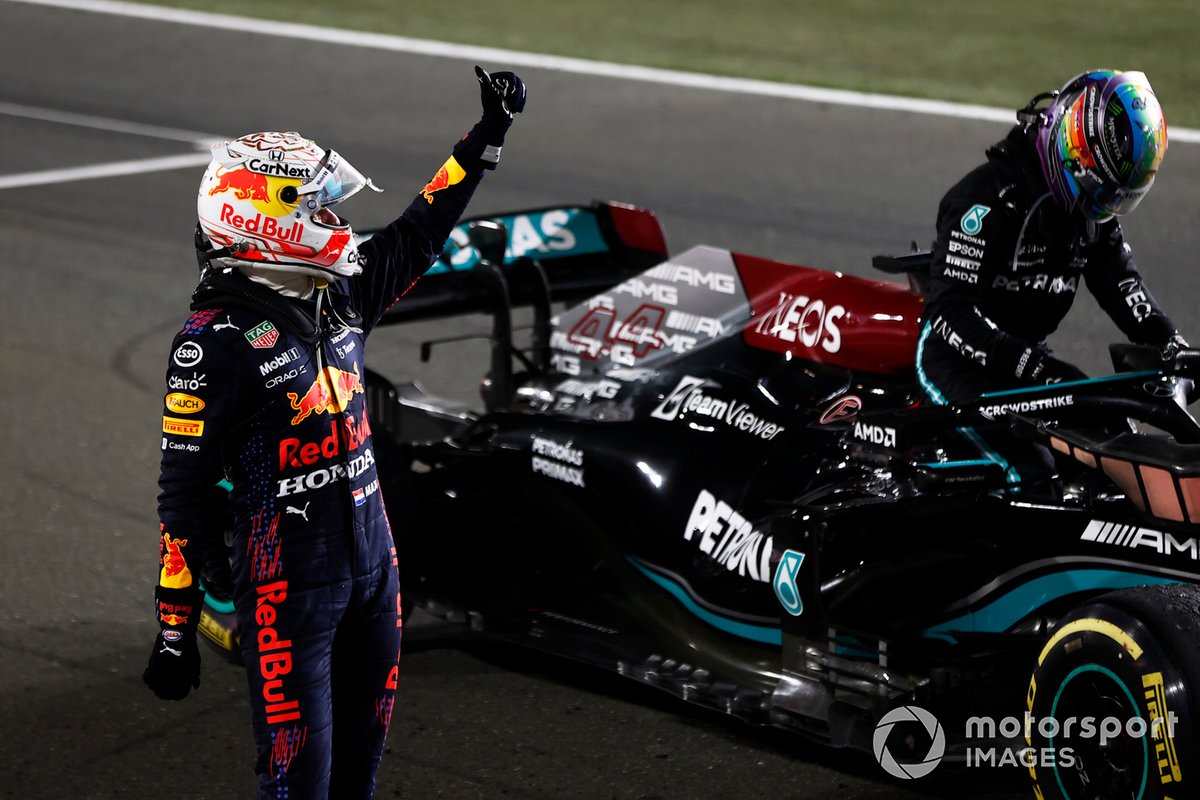
Red Bull's tyre struggles put Verstappen on the back foot in his fight with Hamilton
Photo by: Andy Hone / Motorsport Images
But there was a stunning conclusion to come from Mercedes post-race.
Hamilton had not actually been racing the engine he’d taken a grid drop to receive last time out in Brazil – the one that Red Bull estimates is worth 0.2s in freshness alone. Mercedes was saving it to deploy its potency once again on the high-speed new street track apparently close to being finished in Jeddah.
“There are two [engines] that we are racing,” explained Shovlin of Hamilton’s remaining, and expanded power unit pool. “Here we had the less powerful of the two in the car due to the nature of the circuit.”
F1’s first Qatar GP was a Hamilton masterclass. It shouldn’t escape anyone’s attentions that he simply could have finished further ahead with his full engine might.
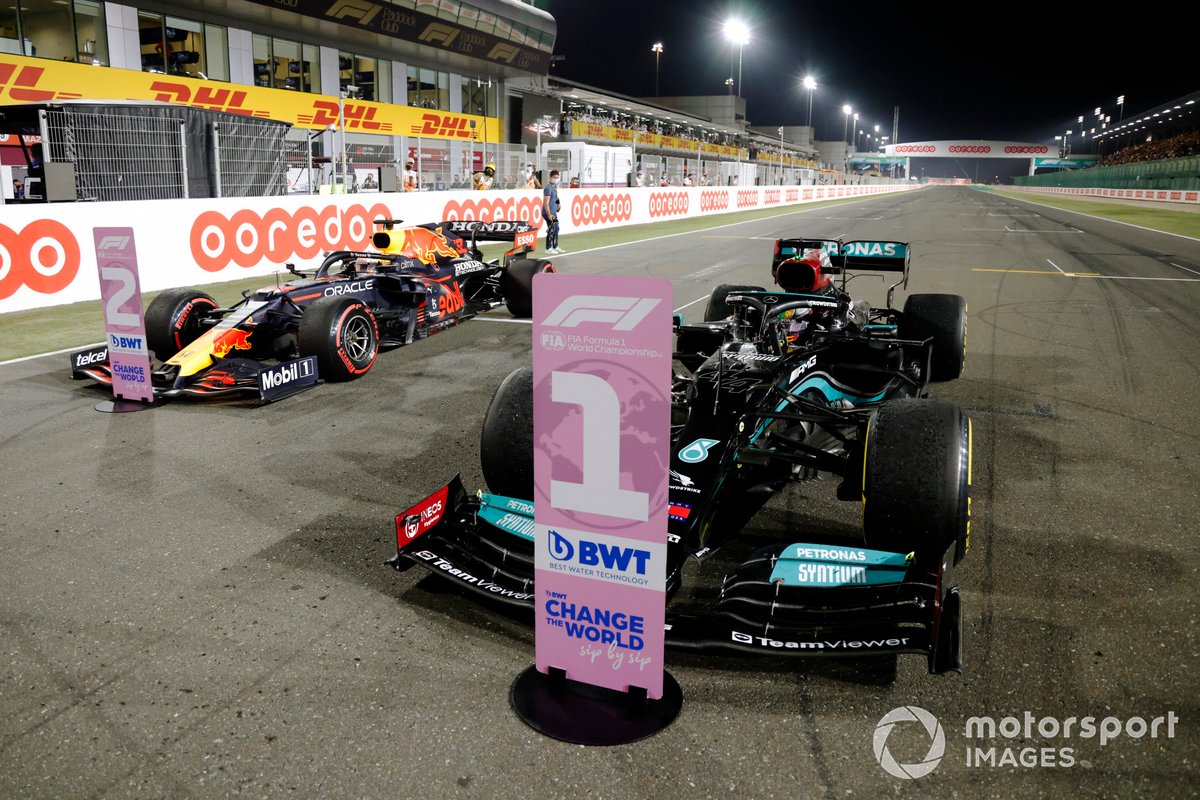
Even without Brazil-spec engine, Hamilton was a cut above in Qatar
Photo by: Steven Tee / Motorsport Images


Why Britain’s role in Formula 1 endured a troubled start

Why Bottas believes his F1 reserve driver role is the fastest route back to a race seat

Why Norris is now ready for his final exam

The key advantage for Bottas vs Perez in the 2026 F1 return race

Why Ferrari's management is under pressure after its bad start to F1 2025, not Hamilton or Leclerc

Why Red Bull can’t solve its second F1 car problem with a simple paint job

Hirakawa replaces Doohan at Alpine for Japanese GP FP1 outing

How Alonso and Bortoleto can be F1 rivals in a unique driver management deal

McLaren targets Norris’ costly fuel system issue with Singapore F1 power unit fixes

How Ford is "hitting milestones" in preparation for WEC Hypercar assault

Audi F1 drivers reveal biggest engine limitation – and why they’re not worried

The USA’s WRC return and 2027 key calendar questions answered
Subscribe and access Autosport.com with your ad-blocker.
From Formula 1 to MotoGP we report straight from the paddock because we love our sport, just like you. In order to keep delivering our expert journalism, our website uses advertising. Still, we want to give you the opportunity to enjoy an ad-free and tracker-free website and to continue using your adblocker.


Top Comments