


Why Quartararo’s Catalunya suit penalty highlights a wider issue in MotoGP
OPINION: Fabio Quartararo racing with his leather suit open and subsequent penalty has been the main talking point of the Catalunya MotoGP weekend, which has highlighted a wider issue with MotoGP’s stewarding that risks a negative precedent going forward

Unsurprisingly, Fabio Quartararo’s decision to race on despite a suit malfunction during the Catalan Grand Prix and his subsequent penalty has split the MotoGP paddock and social media right down the middle.
With around five laps to go of the Barcelona race, Quartararo’s Yamaha leathers completely unzipped themselves and he was seen discarding his chest protector through Turn 3 before carrying on to the chequered flag with his torso completely exposed.
The issue ultimately dropped Quartararo – who was struggling with grip anyway late on - out of the battle for victory with KTM’s Miguel Oliveira, while a track limits violation at the first two turns netted him a three-second time penalty and dropped him from third to fourth at the chequered flag.
It wasn’t until several hours after the race had concluded that the FIM Stewards Panel decided Quartararo’s suit drama warranted him a further three-second time penalty, which dropped him from fourth to sixth in the final race classification.
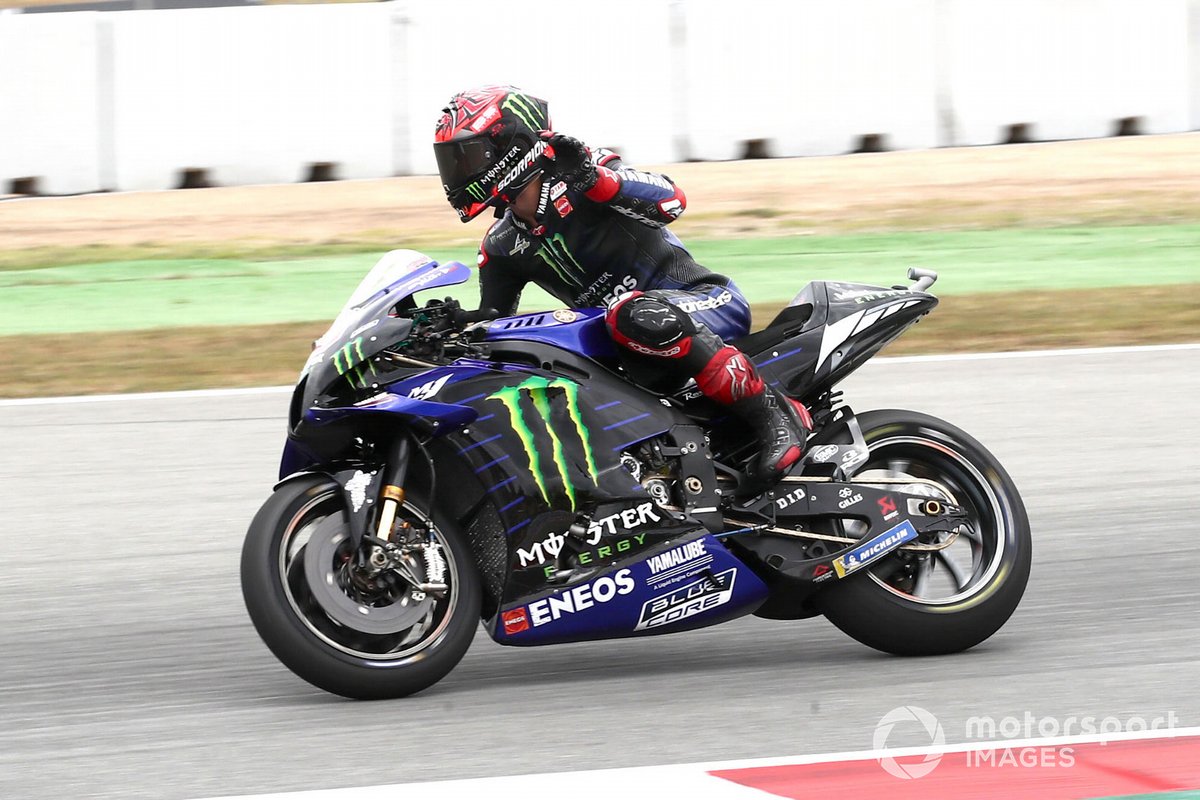
Fabio Quartararo, Yamaha Factory Racing
Photo by: Gold and Goose / Motorsport Images
It was a decision that is unlikely to have satisfied anyone. Though it’s unclear who protested to the stewards, Quartararo was of the mind that the issue warranted no further action. The problem already cost him positions, while his day was compounded by a track limits penalty.
“Well, I think I already have a penalty that I don’t agree [with], demoted three seconds from P3 to P4,” he said. “But I think this penalty is quite enough. But at the end, it’s finished, the race is finished. The safety… we finished the race, everything is safe. So, I think right now it’s not enough to talk anymore because the race is finished. I think there’s no point to talk anymore about these possible things.”
Ultimately, Quartararo’s suit problem and subsequent decision to continue riding in spite of it is a safety issue – a raw topic at the moment in the wake of Moto3 racer Jason Dupasquier’s death at Mugello just a week ago.
Though it’s unclear who protested to the stewards, Quartararo was of the mind that the issue warranted no further action
The official FIM MotoGP regulations make it clear that safety equipment must be worn and properly fixed when on track, the exact working reading: “The equipment must be worn, correctly fastened, at all times during on-track activity.” Clearly, Quartararo didn’t comply with this when his leathers came undone.
However, there’s nothing in the regulations which state what penalty such an offence would warrant. Some have argued Quartararo should have recognised the situation, slowed in a safe place and adjusted his suit before carrying on. But that decision should never have been his to make in the first place.
“For sure when you have gloves on in the middle of the race it’s difficult to close it back,” Pol Espargaro said when asked if Quartararo’s actions were correct. “But I don’t know, it’s not my job. If it’s black flag or whatever, I don’t know. We’re going to talk in the Safety Commission but it was an issue with the leather. I’m sure he didn’t want to open the leathers during the race. [I would have] just done what he did, continue racing and just try to finish as much in front as possible.”

Fabio Quartararo, Yamaha Factory Racing MotoGP
Photo by: Gold and Goose / Motorsport Images
Espargaro wasn’t the only rider to concede he’d have probably done the same as Quartararo, which is why Race Direction should have either shown him the black flag with orange disc to warn of a technical issue or disqualified him altogether. Had Quartararo crashed with his leathers open the consequences could have been grim for him, so Race Direction really had a duty of care to save Quartararo from himself.
This is the view Ducati’s Jack Miller took, stating: “At the end of the day we’re all racers, you have to say to us ‘ok, the leather suit burst open’ and you have to say to us ‘you have to stop the race for this’, for sure we’d be quite angry. But I think at the end of the day riders, especially when you are in that situation, you are not thinking about safety or thinking about yourself. You’re thinking only about the result, so somebody needs to watch this because we can’t be trusted.”
Where Quartararo’s conduct was perhaps questionable was when he ditched his chest protector at Turn 3, which rankled Suzuki’s Joan Mir, who felt this action “put the other riders in danger” as it could have hit someone. He felt this was “punishable”, which led to Quartararo swiping back on social media: “Congratulations to all the people that go to complain for another penalty. I put nobody in danger, like a ride says, and it was already tough for me to ride. But great to see the real faces of some people.”
Naturally, Quartararo was upset that the matter went further than it did. And there is some justification for that. There is precedent for a penalty for such an offence. At Austria last year during Moto3 qualifying, Jaume Masia rode his crashed Leopard Honda back to pitlane without his gloves on – while also spewing oil onto the circuit and delaying proceedings – and was thrown out of the Q2 sessions.
But from a certain point of view, the wording of the FIM rule, specifically where it says “during all track activity” means there’s an argument to be made that riders who throw gloves into the crowd (in pre-COVID times, of course) on cooldown laps contravene the rules. Surely “all track activity” must refer to whenever you are on track, regardless of session status? Take Scott Redding’s antics after the 2018 Valencia race. He stripped down to his underwear and rode back to pitlane for fun. But accidents on cooldown laps aren’t uncommon, so at racing speeds or otherwise the danger is always present.
Analyse the current rule surrounding safety equipment further and another question arises: how is Quartararo riding with his leathers open any different from someone continuing to race a crashed motorcycle?

Fabio Quartararo, Yamaha Factory Racing
Photo by: Gold and Goose / Motorsport Images
The aforementioned Masia incident in Austria is a prime example. His Honda was damaged significantly but was intact enough for him to still ride it back to the pitlane. But as he rounded the penultimate corner, a pipe broke off and deposited fluid over the circuit. In 2012, the British Superbike Championship brought in a no-remount rule after some leaked oil covered a wet Brands Hatch surface following a tumble, which effectively led to the cancellation of most of the races that day. During the 2016 Austrian Moto2 race, Sam Lowes crashed after his right handlebar broke off during braking – a legacy of an earlier tumble in the same race.
What actually happened with Quartararo’s race suit is unknown at this stage, but Alpinestars said that following a first assessment, they found “all zippers and fasteners fully functioning” and said all the suit’s componentry, including the Tech-Air Airbag System, was intact.
What is clear, however, is the incident has highlighted further issues with MotoGP’s stewarding process – which has been under fire for some time now from riders over various questionable decisions.
A three-second time penalty seems nothing more than a decision made to appease, but will only serve to cause further discord
This, in the end, was a matter of safety, so it’s hard to justify any decision that didn’t involve either the black flag or technical flag. This is a view that ultimately Quartararo shares in, after the Frenchman admitted on Monday after the race that he should have been disqualified.
“Yes, first of all, yeah I think looking back at what happened now the story is finished I can be happy because it’s difficult to admit, but for me it was black flag,” he conceded when asked by Autosport if he’d had time to reflect on his penalty.
“I mean, it’s true that I put in danger myself and also with what happened last week I think it was the correct thing. But I was lucky. The only penalty I don’t agree with was the shortcut because I don’t feel it was fair. I lost seven tenths, but if I lost one second the penalty was gone, and how do I know on the bike I lose seven tenths of one second? So, that was a little bit stupid. But I admit the second penalty. I was angry, of course, but better this than zero points.”
A three-second time penalty seems nothing more than a decision made to appease, but will only serve to cause further discord. And without any rewriting of the rules, this penalty sets a bad precedent should this situation arise again.

Polesitter Fabio Quartararo, Yamaha Factory Racing
Photo by: Gold and Goose / Motorsport Images


MotoGP 2025: Full rider line-up revealed

A year on from Marquez’s Germany MotoGP meltdown, has Honda improved?

What’s behind MotoGP’s right-hander chaos in Germany practice?

MotoGP German GP: Vinales on record pace in FP2 as Marquez suffers huge crash

MotoGP German GP: Martin leads Marquez, Vinales in first practice

F1 champion Hamilton “interested” in MotoGP amid Gresini buyout links

Quartararo outlines his preference for Pramac’s 2025 MotoGP line-up

The hockey expansion rule that could benefit Andretti's F1 bid

Fortescue Zero purchases Team Penske for Formula E's Gen4 era

FIA confirms ACO WEC deal runs through 2027 after reported contract row

How Antonelli's luxury problem is causing Wolff and Mercedes grey hairs

WRC secures major three-year broadcast deal with BBC
Subscribe and access Autosport.com with your ad-blocker.
From Formula 1 to MotoGP we report straight from the paddock because we love our sport, just like you. In order to keep delivering our expert journalism, our website uses advertising. Still, we want to give you the opportunity to enjoy an ad-free and tracker-free website and to continue using your adblocker.


Top Comments