


How wider 2017 tyres will make F1 pitstop times harder to replicate
Formula 1 teams face a challenge to match last year's rapid pitstop times with the wider 2017 tyres


This season's bigger and bulkier tyres - 60mm wider at the front and 80mm wider at the back - create complications with their extra weight and deeper rims.
Williams was the pitstop benchmark last year, producing the fastest stops at 11 of the 21 grands prix - including a 1.92-second peak in Baku.
Its sporting manager Steve Nielsen said Williams had designed new equipment for the changes and begun practicing with a 2016 car fitted with heavier wheels last year before Pirelli released the definitive '17 tyres.
"A Williams pitstop involves 34 actions, so 34 things have to happen in the space of two seconds," Nielsen told Autosport.
"Any one of those going wrong can stop you and delay the pitstop. "Of those 34 actions, 12 are affected by the bigger and heavier wheels.
"For example, the wheelnut, particularly on the rears, is further inside so it is more difficult for the gunman to get to.
"There is a degree of change to the equipment and technique that had to be developed to cope with that."
The wider rims mean wheelnuts will be visible for less time as the car comes in, but Nielsen said that had not proved as challenging as the sheer size increase.
"We were afraid of that before we started practicing with the real kit, but that has actually not been as much of a fuss as we thought it might be," Nielsen said.
"The limiting factor is actually the transition - from the moment the wheel is undone, getting that wheel off and putting the next one on.
"That is where we are seeing the extra time creeping in.
"It's because there are three people moving within a few centimetres of each other and this wheel is much, much wider than it was.
"So the clearances between the crew have to be more, they have to give each other more space and that adds a tenth or two."
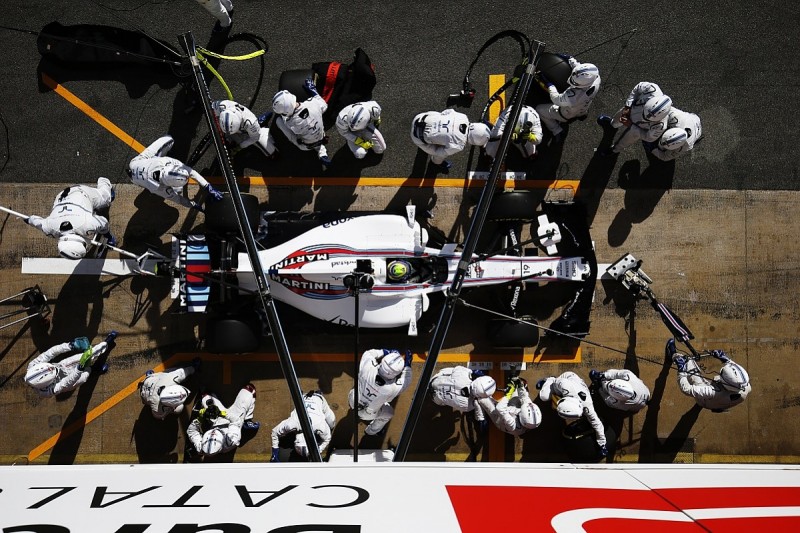
Nielson believes it is still possible to match 2016 pitstop times, but harder to do so consistently.
"What we have seen so far is that the ultimate times that we were doing last year are still achievable, but there is just more of a scatter," he said.
"A very good pitstop last year was perhaps two seconds, or just under.
"We can still hit those targets, but there is more of a spread down to the 2.4s, 2.5s, 2.6s - more than we were seeing last year.
"Although it is very nice to do a 1.9s pitstop, everyone talks about it, it is great, and it is a sort of badge of pride, the most important thing for us is the consistency.
"So if you are doing four stops, there is no point doing one at 1.9s if the others are 3.5s.
"I would sign now for them all being sub 2.5s."
Share Or Save This Story


Brundle awarded OBE in King’s New Year’s honours

The new rules dilemma that will define the 2025 F1 season

Jon Noble: An unfair perception or a genuine concern? Lifting the lid on Red Bull’s Tsunoda scepticism

The data behind Russell’s engine software issue that caused his Hungarian GP slow start

United Formula Ford battles add European flavour to USA Snetterton 300 event

Red Bull appoints Lagrue as junior driver chief after Mercedes F1 exit

Dome-led group launches bid to build next Super Formula car
Subscribe and access Autosport.com with your ad-blocker.
From Formula 1 to MotoGP we report straight from the paddock because we love our sport, just like you. In order to keep delivering our expert journalism, our website uses advertising. Still, we want to give you the opportunity to enjoy an ad-free and tracker-free website and to continue using your adblocker.


Top Comments